
Count the tools your team uses to handle one resident. To start, there's the phone system, then the texting platform, the voicemail box, the scheduling link, the work-order system, the PMS, and maybe even a separate after-hours answering service stapled on top. Seven places for just one conversation, and they don’t all talk to each other.
That's tech stack fatigue, and it's the real story behind the "we have too much software" complaint. The problem isn’t too many tools; it’s that your tools just don’t communicate well.
More software didn't make it easier. It made it heavier.
Every disconnected tool adds a “tax” you pay in manual re-entry and dropped context. For example: A resident texts about a leak but then calls to follow up…these were two different tools and the person who answers has no idea about the text. Or imagine, a work order gets created in one system, but the resident's history lives in another. An after-hours service takes a message that someone has to manually enter in the system in the morning. The information is all there. It's just scattered, so a human has to be the integration layer, carrying details from one screen to the next. Apart from being inefficient, it increases the opportunity for errors.
That isn't a tooling gap. It's the opposite actually: too many systems, each solving one slice of the overall picture.
It's also why integration is now the single biggest barrier to AI adoption in multifamily, ranked ahead of cost and ahead of staff training. Operators have been burned. They've learned that a tool that doesn't connect to what they already run isn't a time-saver at all. It's one more silo and one more login for them to think about.
What operators actually want now
The buying criteria have shifted. The goal isn't to add capability. It's to remove friction. Operators are prioritizing tools that fold into existing workflows and run with minimal daily oversight. Fewer points of failure, fewer places to check, and fewer handoffs where a resident's request can disappear.
In other words, the win is in software consolidation.
One connected platform, not seven point solutions
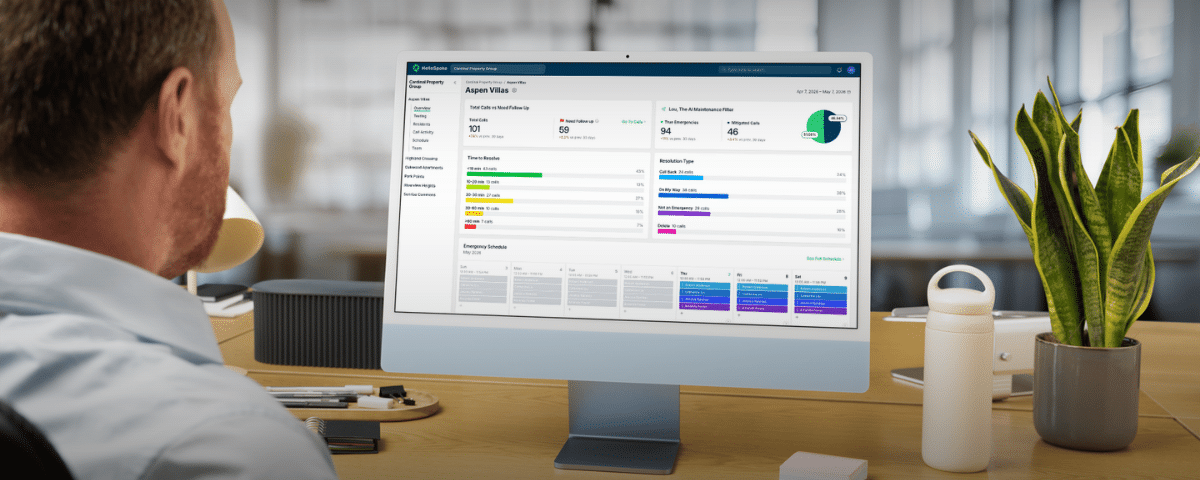
This is the entire idea behind HelloSpoke. Core puts every resident conversation (calls, texts, voicemail) in one system that knows what's urgent and connects directly to your PMS, so resident data stays accurate and work orders sync with no double entry. Your team stops digging through three inboxes to reconstruct what a resident needs. Work orders, call history, and resident context live in the same place, not scattered across vendors.
Assist adds Lou, the conversational AI that answers when your team can't. Because it's built on Core, Lou already has the resident data, the work-order history, and the property context. It isn't another disconnected bot you have to feed separately. It's part of the same system, which is exactly why it works.
The difference you feel isn't "we got a new tool." It's that a resident can text, then call, then get a follow-up, and every step knows what the last one did. Nobody re-keys anything. Nothing falls through the gap between systems, because there isn't a gap.
Consolidation is the upgrade
If your team is fatigued, adding an eighth tool won't fix it, even a great one. The move that actually lightens the load is the opposite: collapse the scattered stack into one connected platform where the calls, the texts, the voicemail, the scheduling, the work orders, and the PMS finally speak the same language.
You don't need more software. You need your software to stop making your team do its job for it.
Tired of being the integration layer between your own tools? Book a demo and we'll show you what one connected platform actually feels like.